
Table of Contents
- Why Your Mind Won't Settle: Understanding the Causes of Inner Turmoil
- Proven Methods to Reduce Daily Stress That Actually Work
- How to Quiet a Busy Mind: Breathwork, Journaling and Grounding
- Daily Habits for Mental Well-Being You Can Start Tonight
- Letting Go of Limiting Beliefs and Building Self-Compassion
- How to Find Inner Peace When Life Won't Slow Down
- Common Mistakes That Block Inner Peace (and What to Do Instead)
- Conclusion: Finding Inner Peace Is a Practice, Not a Destination
- Frequently Asked Questions
Last Updated: September 20, 2026
Why Your Mind Won't Settle: Understanding the Causes of Inner Turmoil
Learning how to find inner peace starts with understanding why your mind feels restless. Inner turmoil is not a personal failing, it is your nervous system responding to real pressure, with clear causes you can work with.
The Modern Triggers That Steal Your Calm
Your brain was never designed for a constant stream of notifications, news and demands. Many people find their attention pulled in dozens of directions before breakfast.
The main triggers tend to be:
- Endless phone alerts and scrolling
- A packed calendar with no gaps
- Comparing your life to everyone else's online
- Unfinished tasks that sit in the back of your mind
How Poor Sleep and Chronic Stress Keep You Stuck
Sleep and stress feed each other in a loop. A poor night's sleep makes you more reactive the next day. That reactivity makes it harder to switch off at night.
Proven Methods to Reduce Daily Stress That Actually Work
The most effective methods to reduce daily stress are the ones you will actually repeat. Grand plans collapse under pressure. Small, consistent actions hold up.
Here is what tends to work:
- A short walk outside, ideally in daylight
- Slow breathing for two to three minutes
- Writing down what is worrying you
- One clear boundary around your working hours
- A wind-down routine before bed
How to Quiet a Busy Mind: Breathwork, Journaling and Grounding
To quiet a busy mind, give it one simple thing to focus on instead of fifty. Breathwork, journaling and grounding each do this differently, and knowing the mechanism helps you pick the right tool for the moment.
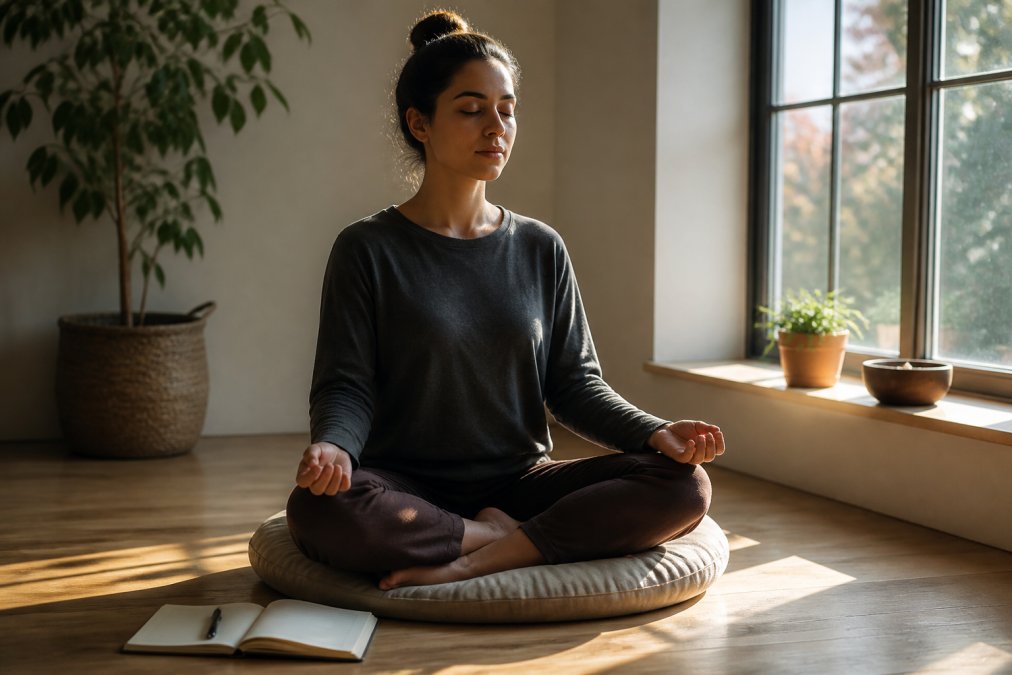
Breathwork You Can Do in Five Minutes
Breathwork is the fastest way to calm your body because slow, extended exhales activate the parasympathetic branch of your nervous system, the part responsible for rest and recovery. That is why a longer out-breath feels more settling than a longer in-breath.
Try this simple pattern:
- Sit comfortably and let your shoulders drop
- Breathe in through your nose for a count of four
- Hold gently for a count of four
- Breathe out slowly for a count of six
- Repeat for five minutes
Journaling to Untangle Mental Clutter
Journaling works because it moves worries out of your head and onto the page. This is sometimes called externalising: a vague, looping worry becomes a specific, bounded problem you can look at rather than feel.
A simple approach:
- Write for five minutes without stopping
- Do not edit or judge what comes out
- End with one small action you can take
Grounding Techniques for When Your Mind Won't Stop
Grounding is the third tool, and the one to reach for when thoughts are racing and breathwork alone is not enough. The aim is to anchor attention in your physical senses rather than the story your mind is telling.
A widely used method is the 5-4-3-2-1 technique:
- Name five things you can see
- Four things you can feel
- Three things you can hear
- Two things you can smell
- One thing you can taste
How to Choose Between Them
A practical rule: use breathwork when your body is activated (racing heart, tight chest), journaling when your mind loops on the same thought, and grounding when you feel disconnected or overwhelmed. Over a week, try all three and keep the easiest, that is the one you will stick with.
Daily Habits for Mental Well-Being You Can Start Tonight
The daily habits for mental well-being that matter most protect your sleep, your body and your attention, and you can start all of them tonight.
- Set a fixed bedtime and stick to it
- Put your phone in another room an hour before bed
- Get a few minutes of daylight early in the day
- Move your body, even briefly
- Write down three things that went well
- Do one grounding technique before sleep
Letting Go of Limiting Beliefs and Building Self-Compassion
Limiting beliefs are the quiet stories you tell yourself, such as "I'm not good enough" or "I'll never feel calm." Left unchallenged, they keep inner peace out of reach.
How to Find Inner Peace When Life Won't Slow Down
You do not need a quiet life to find inner peace, you need a few clear boundaries and a practice you can return to, even on busy days. Most advice assumes you can step away from everything. You cannot, so the skill is to find calm inside the noise, not only in silence.
Setting Boundaries With Digital Noise
Digital noise is one of the biggest barriers to tranquillity: every alert pulls your attention outward and away from the present moment. The problem is not the technology but the frequency of interruption, since each one carries a switching cost that lingers for minutes afterwards.
Try these:
- Turn off non-essential notifications
- Set two or three fixed times to check messages
- Keep your phone out of the bedroom
- Take one short digital detox each week
Finding Calm in a High-Pressure Working Environment
Most inner-peace advice is written as if your day is your own. For many people, it is not. If you work in a demanding role, the practical question is not how to escape pressure but how to hold your centre inside it.
- Transition rituals. Create a short, repeatable action that marks the end of work and the start of your own time. It might be a walk around the block, changing clothes, or three minutes of slow breathing before you open the door at home. The ritual matters more than its content.
- Micro-recovery between tasks. Rather than waiting for a lunch break that never comes, take sixty to ninety seconds between meetings to breathe slowly and reset. Small, frequent recovery beats one long break you never take.
- One boundary you actually keep. Choose a single non-negotiable, such as not checking email after a certain hour, and protect it. One boundary held consistently is worth more than five that collapse under pressure.
- Reframe the pressure, not the feeling. You cannot always remove the stressor, but you can change what you tell yourself about it. "This is hard and I am coping" is a different internal state from "I cannot handle this."
The Trauma-Informed Caveat
For some people, the standard advice to "sit with your feelings" or "notice the thought and let it pass" is not enough, and can even be counterproductive. If you have a history of trauma, intense emotions may need a gentler approach, often with professional support, rather than solo breathwork or journaling alone.
A Note on What Peace Is Not
Inner peace in a busy life does not mean feeling calm all the time, it means recovering faster when you are not. The goal is not the absence of stress but a shorter return to baseline, a more realistic and durable target than perpetual serenity.
Common Mistakes That Block Inner Peace (and What to Do Instead)
Most people block their own progress without realising it. Here are the mistakes we see most often, and the fix for each.
| Mistake | What It Looks Like | What to Do Instead |
|---|---|---|
| Chasing a quick fix | Expecting calm in one day | Treat it as a daily practice |
| Fighting your thoughts | Trying to force your mind to be blank | Notice the thought and let it pass |
| Skipping sleep | Late nights, early alarms | Protect a fixed bedtime |
| Avoiding all discomfort | Numbing with screens or food | Sit with the feeling briefly |
| Going it alone | No support or guidance | Use structured tools and support |
Conclusion: Finding Inner Peace Is a Practice, Not a Destination
Finding inner peace is not a single achievement you tick off a list. It is a practice you return to, day after day, especially on the hard ones.
Frequently Asked Questions
How do I start finding inner peace when my mind won't stop racing?
Start with one small practice, not a complete overhaul. Try five minutes of slow breathing, inhaling for four counts and exhaling for six, once a day. The longer exhale signals safety to your nervous system and slows your heart rate. Pair it with a two-minute journaling session where you write down whatever is circling in your head. These two habits alone, done consistently, reduce mental clutter within a week or two for most people.
What daily habits for mental well-being make the biggest difference?
Sleep timing, morning light, and movement matter more than most people expect. Going to bed and waking at consistent times stabilises your mood and emotional regulation. Ten minutes of daylight within an hour of waking helps set your body clock. A short walk, even fifteen minutes, lowers stress hormones. Add one gratitude note each evening and one screen-free hour before bed. These habits work together and compound over weeks.
Can breathwork and meditation really help with long-term stress?
Yes, and the evidence is strongest for practices done regularly rather than intensely. Breathwork with extended exhales activates the parasympathetic nervous system, which counteracts the stress response. Meditation builds your ability to notice thoughts without reacting to them, which is the core skill behind emotional clarity. Ten minutes daily for eight weeks produces measurable changes in how people handle pressure. Consistency matters far more than session length.
How does poor sleep affect your ability to find inner peace?
Poor sleep amplifies everything. It raises cortisol, sharpens emotional reactions, and makes ordinary problems feel overwhelming. Your inner dialogue becomes more critical and less rational. Fixing sleep is often the fastest route to a quieter mind. Aim for seven to nine hours, keep your room cool and dark, and avoid screens for an hour before bed. If pain keeps you awake, address that first, since no amount of meditation compensates for broken sleep.