
Table of Contents
- How Exercise and Meditation Affect Sleep Differently
- The Best Time of Day to Exercise for Sleep
- Meditation Duration for Sleep Improvement: How Long Is Enough?
- Sleep Hygiene Tips NHS Guidance Backs (And Where Exercise and Meditation Fit)
- Exercise vs Meditation: Which Works Better for Your Sleep Problem?
- Combining Both: A Synergistic Protocol for Restorative Sleep
- Frequently Asked Questions
Last Updated: October 2, 2026
How Exercise and Meditation Affect Sleep Differently
Exercise and meditation improve sleep through separate routes: physical activity builds sleep pressure and calms the stress response, while meditation targets the racing mind that keeps many people awake. This guide compares both, so you can pick the right tool for your sleep problem. Sleep hygiene tips from the NHS Every Mind Matters sleep guidance already back both practices.
The Physiological Effects of Physical Activity on Sleep
Physical activity raises your core body temperature, then lets it fall several hours later. That drop helps trigger sleep onset. Movement also builds adenosine, the compound that creates sleep pressure, and it lowers cortisol levels over time.
The Role of Meditation in Stress Reduction and Sleep Onset
Meditation works on the other half of the problem: the mind that will not switch off. Mindfulness meditation activates the parasympathetic nervous system, pulling you out of the fight-or-flight response that keeps sleep latency high.
The Best Time of Day to Exercise for Sleep
The best time of day to exercise for sleep is the late afternoon or early evening, roughly four to six hours before bed. This timing lets your core temperature rise and fall before you turn in, which supports sleep onset.
Why the Four-to-Six-Hour Window Works
When you exercise, your core body temperature climbs and stays elevated for several hours. As it drops again, it signals to your circadian system that sleep is approaching. A late-afternoon session puts that drop right around bedtime, which is why many people find it easier to fall asleep on training days.
Morning vs Late Afternoon vs Evening
- Morning (within an hour of waking): best for anchoring your circadian rhythm and protecting a consistent wake time. Daylight exposure during outdoor exercise strengthens this effect. Sleep onset may not improve as sharply, but sleep regularity often does.
- Late afternoon (roughly 4pm to 6pm): best for temperature-driven sleep onset. This is the slot most sleep practitioners point to when someone wants a single change with the clearest effect.
- Early evening (7pm to 9pm): fine for light activity such as walking, stretching, or gentle yoga. Vigorous training here is where problems start for some people.
- Final hour before bed: keep it gentle. A hard session this late can leave you too alert to drift off, and it can push sleep onset back by an hour or more.
When Exercise Actually Hurts Sleep
This is the part most guides skip. Exercise is not universally sleep-promoting, and for some people the timing or intensity works against them.
Other situations where exercise can work against sleep:
- Very late evening training on an empty stomach, which can leave you wired and hungry at the same time.
- A sudden jump in training volume, which raises overnight cortisol and can cause lighter sleep for a few nights.
- Outdoor sessions under bright artificial light close to bedtime, which can delay melatonin release.
- Competitive or high-stakes training in the evening, where the mental arousal outlasts the physical fatigue.
Matching Timing to Your Chronotype
A night owl and a morning lark should not follow the same schedule.
Meditation Duration for Sleep Improvement: How Long Is Enough?
Meditation duration for sleep improvement does not need to be long. Ten to twenty minutes of guided practice before bed is enough for most people to notice a calmer wind-down.

Sleep Hygiene Tips NHS Guidance Backs (And Where Exercise and Meditation Fit)
Sleep hygiene tips NHS guidance backs include a fixed wake time, a dark and cool bedroom, and a wind-down routine before bed. Exercise and meditation slot into that routine as the two active ingredients.
Exercise vs Meditation: Which Works Better for Your Sleep Problem?
Exercise vs meditation comes down to the type of sleep disturbance you have. Trouble falling asleep usually points to a mind problem, which meditation addresses. Waking during the night often points to stress load and arousal, where regular exercise helps more. Poor sleep quality without obvious waking points to a mix of both.
If You Struggle to Fall Asleep
If you struggle to fall asleep, meditation is usually the faster lever. Sleep latency is driven by a racing mind and physiological arousal, and a short guided practice before bed lowers both.
A practical sequence for sleep-onset problems:
- Days 1 to 7: ten minutes of guided meditation at bedtime, no other changes.
- Days 8 to 14: add 20 to 30 minutes of aerobic exercise earlier in the day.
- Week 3 onward: keep both, and adjust the meditation length to whatever you can sustain.
If You Wake During the Night
If you wake during the night, exercise tends to help more. Night waking is often linked to stress load, cortisol levels, and shallow sleep architecture, and consistent aerobic exercise improves all three over weeks, not days.
If Your Sleep Quality Is Poor but You Do Not Wake
This is the pattern most articles ignore. You fall asleep reasonably quickly, you do not remember waking, but you wake unrefreshed. Sleep feels shallow rather than broken.
Here, the two practices work on different layers:
- Exercise deepens slow-wave sleep over time, which is the stage most associated with physical restoration. Consistent aerobic activity is the strongest lever here.
- Meditation reduces the mental noise that fragments sleep architecture without fully waking you. It also lowers the pre-sleep arousal that keeps you in lighter stages.
If You Have Been Diagnosed with Insomnia
If you have a diagnosed sleep disorder such as clinical insomnia, neither exercise nor meditation replaces evidence-based treatment. Cognitive behavioural therapy for insomnia is the first-line approach recommended in clinical guidance, and both exercise and meditation work well alongside it rather than instead of it.
A Quick Self-Check
Before you commit to one practice, answer three questions:
- How long does it take you to fall asleep on a typical night?
- How many times do you wake, and do you remember why?
- Do you wake feeling restored, or merely rested?
Your answers point to the right starting lever. If you are unsure, start with exercise earlier in the day and meditation at bedtime, the combination covers the widest range of sleep problems, and you can refine from there.
Combining Both: A Synergistic Protocol for Restorative Sleep
Combining both works better than choosing one. Exercise builds the physical need for restorative sleep, and meditation removes the mental barrier to reaching it. Together they cover both halves of the sleep problem.
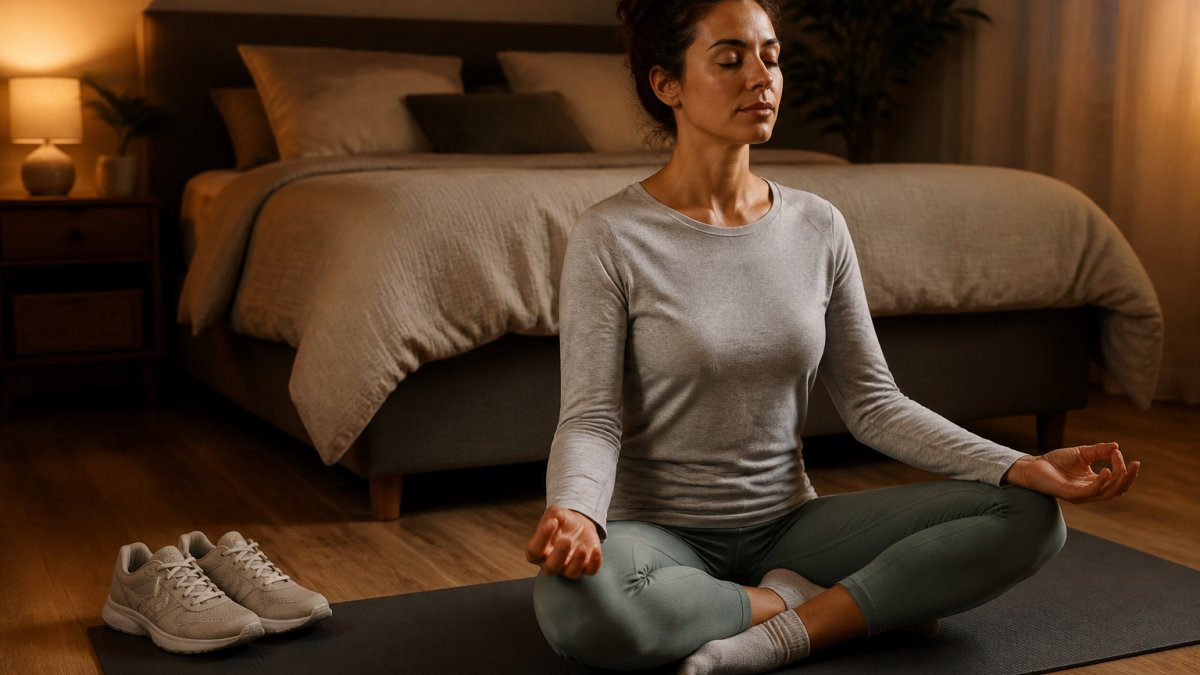
Here is a simple weekly protocol to follow:
- Morning: 20 to 30 minutes of aerobic exercise, ideally outdoors
- Afternoon: a short walk to break up sitting
- Evening: light stretching or yoga, never vigorous training
- 30 minutes before bed: screens off, lights dimmed
- In bed: 10 minutes of guided meditation or a body scan
- If you wake: slow breathing, no clock-watching
- Same wake time every day, weekends included
Frequently Asked Questions
Does physical activity improve sleep quality more than mindfulness?
Research suggests both work through different pathways. Aerobic exercise reduces sleep latency by tiring the body and regulating circadian rhythm, while mindfulness meditation calms the fight-or-flight response that keeps racing thoughts active at night. For people whose insomnia stems from physical restlessness, exercise often produces faster results. For those whose sleeplessness comes from anxiety or a busy mind, meditation tends to help more. Many sleep specialists recommend combining both rather than choosing one.
What is the best time of day to exercise for better sleep?
Most evidence points to morning or early afternoon exercise for the strongest sleep benefits. A workout finishing at least three hours before bed gives cortisol levels time to drop and body temperature to fall, both of which support sleep onset. Moderate aerobic exercise in the late afternoon can still work well for many people. High-intensity training within two hours of bedtime risks leaving you wired and delaying sleep.
How long should I meditate before bed to see improvement?
Short sessions work. Ten to fifteen minutes of guided mindfulness meditation before bed is enough for most people to notice calmer sleep onset within two to three weeks of consistent practice. Longer sessions of twenty to thirty minutes may deepen the effect for people with clinical insomnia, but consistency matters more than duration. Even five minutes of slow breathing counts as a starting point.
Can meditation replace the need for deep sleep?
No. Meditation and sleep serve different functions. Deep sleep and REM sleep allow the body to repair tissue, consolidate memory, and regulate hormones. Meditation reduces physiological arousal and helps you fall asleep faster, but it does not substitute for the restorative stages of sleep architecture. Treat meditation as a tool that improves sleep quality, not a replacement for sleep duration.
How long before bed should you stop exercising?
Aim to finish moderate or vigorous exercise at least three hours before bedtime. This gives your core body temperature time to drop and cortisol levels to settle, both of which support sleep onset. Light activity such as stretching or a short walk in the evening is fine and can even help relaxation. If evening is your only option, keep the intensity low and pair it with a wind-down routine.
Poor sleep rarely has one cause, and it rarely has one fix. Nader care exists for exactly this: natural, knowledge-led tools to help you sleep better tonight and build a quieter mind over time. Our ebooks cover natural sleep methods and personal empowerment through knowledge, backed by personalised 7-email support so you are never guessing alone. Get started with Nader care and take the first step toward deeper sleep.